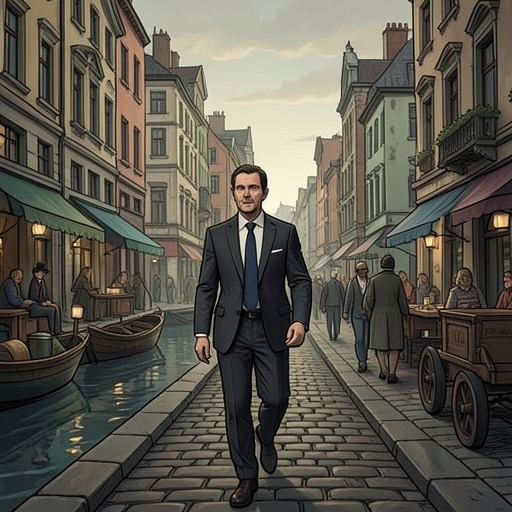
Founding of Venice
Across the River and into the TreesThe founding of Venice, as Colonel Richard Cantwell recounts it to Ronald Jackson, begins not with a single act of construction but with a community forced to change where and how it lived. In his account, Torcello’s people faced a landscape made unhealthy by flooding and malaria, as well as the danger of invasion; they answered by moving building materials by boat to a more defensible place. The episode joins environmental upheaval to human choice, while Cantwell’s own attachment to Venice gives the history the force of a personal inheritance.
The landscape that prompted departure
Cantwell points across the lagoon to Torcello and identifies it as the place where people driven from the mainland by the Visigoths had settled. He says that thirty thousand people once lived there and built the church whose square tower remains visible from the road. The story’s turning point comes after that settlement had been established: the mouth of the Sile River silted up, or a major flood altered it, and the surrounding land flooded. Cantwell links the resulting marsh conditions to mosquitoes and malaria, which began to kill the inhabitants. The founding story therefore makes the natural environment neither a static backdrop nor a simple refuge. A change in the water system undermines the health of the original settlement and makes relocation necessary.
Disease was not the only pressure. Cantwell describes the people as seeking a healthier place that could be defended by boats, beyond the reach of the Visigoths, the Lombards, and other raiders who lacked sea power. In this account, the lagoon offers protection because it rewards a particular kind of mobility: people who can travel and fight by boat can use the water and its islands to their advantage. The city’s origin is thus framed as a response to both ecological vulnerability and political danger, rather than as a planned expansion from a secure mainland base.
Moving a settlement by water
Cantwell’s decisive detail is practical and material. The people of Torcello loaded the stones of their houses onto barges and used them to build Venice. The move does not appear as an abstract migration alone: the old homes’ building material travels with the community, turning displacement into construction. The account suggests continuity through reuse. What was built in the new place depended on what could be carried from the old one, and the water that had helped isolate Torcello became the route by which its people and their materials could establish another settlement.
The people undertaking that move are described as experienced boatmen. Cantwell traces their origins to Caorle and says that, when the Visigoths overran the region, they drew people from towns and farms behind them into the migration. His explanation therefore gives the founders a broader base than Torcello alone: a core community is joined by people displaced across the surrounding mainland. The resulting Venice is presented as a settlement made by collective movement and maritime skill, with defense, transport, and building bound together in the same response.
A city’s founding in Cantwell’s telling
The account is delivered during Cantwell and Jackson’s journey toward Venice, when the city’s landmarks become visible across the marshes. Cantwell points out Torcello’s square church tower and the campanile of Burano, then explains how the people of Torcello came to build Venice. When he pauses to ask whether he is boring Jackson, the driver answers that he had not known who pioneered the city. The exchange makes the history an act of instruction within the present journey: the visible landscape prompts the story, and Jackson’s response confirms that Cantwell is giving him a way to read it.
Cantwell also connects the founding to the later civic identity of Venice through the story of Saint Mark’s remains. He recounts that a Torcello man, running arms into Alexandria, located the body of Saint Mark and smuggled it out concealed beneath fresh pork so customs guards would not inspect it. The man brought the remains to Venice, where Saint Mark became the patron saint and a cathedral was built in his honor. In Cantwell’s telling, the founders’ seafaring ability continues beyond migration and settlement: it enables distant trade and a daring transfer that helps shape the city’s religious and civic symbolism. He regards the architecture of the later trading city as Byzantine in character, while insisting that the builders never surpassed what they had made at the beginning in Torcello. That judgment makes the origin place not merely a point of departure but the measure by which he evaluates Venice’s built history.
Memory, belonging, and the city’s beginnings
Cantwell’s version of the founding is inseparable from his own sense of belonging. Earlier on the same journey, he recalls fighting along the Piave as a boy, when the defenders were trying to protect Venice without being able to see it. He remembers a later clear, cold day near Noghera when the city finally appeared across the water, and reasons that fighting for it made it his city, even though he had not been born there. The historical migration he recounts to Jackson consequently resonates with his own experience of attachment formed through danger and effort: in both stories, a relation to Venice is made through defending or reaching it.
The contrast between Venice’s remembered origins and the present landscape is not a claim that the city escaped later change. Elsewhere on the route, Cantwell sees the Piave’s old positions beside canals and recalls that during the war dead were thrown into them; because the gates downstream were closed, the bodies remained in the stagnant water until labor troops removed and buried them. This is a separate history from the founding, but it reinforces the book’s attention to waterways as places shaped by human decisions and remembered through their consequences. Against that scarred landscape, the account of Torcello’s boatmen offers another history of adaptation to water: not a timeless legend of a city rising untouched from the lagoon, but a story of people responding to flood, disease, and invasion with the materials and skills available to them.
Cantwell’s later movements through Venice extend the same sense of lived connection into ordinary practice. He treats walking without counting streets or bridges, finding his way through the city to the market, as a game whose reward is the happiness of the eye and heart. From the Gritti Palace Hotel he also makes familiar journeys through bridges and squares to Harry's Bar in Venice, describing his arrival there as being home. These episodes do not add further causes to the founding; they show what the founding story means to him. The city first appears in his account as a refuge made by displaced boatmen, and in his present life it is a place known through repeated passage, observation, and attachment.